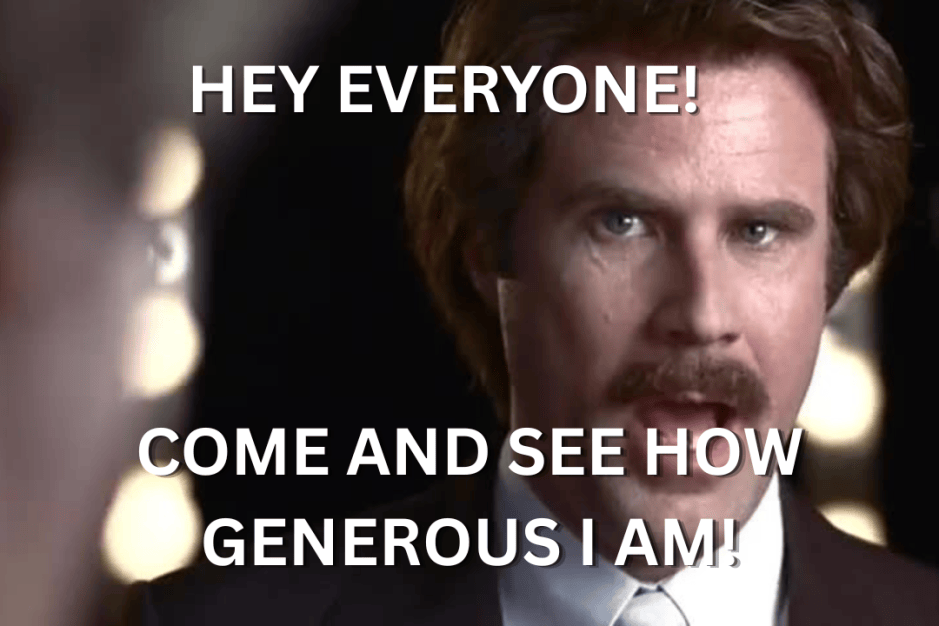
The Most Generous Person in the World

Who is the most generous person in the world?

It’s a hard question, with many ways to answer.

If we measure generosity by dollar amount, then the usual names come up. Bill Gates. Warren Buffett. Billionaires giving away billions.

Fair enough.

But the deeper you go into the question, the harder it becomes to answer.

If generosity is measured by percentage given away, then maybe Chuck Feeney belongs near the top. He spent much of his life quietly giving almost all his wealth away.

If generosity is measured by trust, then maybe MacKenzie Scott belongs near the top. She gives large amounts away quickly, and completely trusting the organisations to spend it wisely.

If generosity is measured in time, sacrifice and service to others, then you can’t go past Mother Teresa.

But maybe, some of the most generous people are not people you have heard of.

I think about the parents I know who quietly sacrifice opportunities for themselves so their kids can have them instead.

The friend who answers the phone late at night.

The person who notices someone sitting alone.

The co-worker who makes life easier for everyone else without needing recognition for it.

Tiny acts. Small moments.

Regular people making life a little better for those around them.

Most generosity never gets written about. But I suspect it’s the kind that holds the world together.

The Better Offer

“Thanks, but I got a better offer.”

I’m not sure I’ve heard too many people say that out loud, but certainly that is what they have meant when they let me know that they were unable to attend an event or gathering. Sometimes it is not communicated with words at all, just through them not turning up.

It can feel hard to commit to an event weeks in advance because who knows what else might come up in the meantime?

Sometimes your better offer is listening to your anxiety and staying home.

Sometimes your better offer is choosing one friend over another.

Sometimes your better offer is choosing something that serves you in that moment over what you have already committed to.

There is nothing inherently wrong with any of those choices, but they should be intentional, not habitual.

An underrated act of generosity is simply turning up to something you said you’d go to. Even if you might not feel like it in the moment.

It shows the person that invited that you care. That you respect them. That you recognise the effort it takes to organising something, and that it matters when people come.

And if you can’t make it, letting someone know matters too.

Because people want to be valued and that is often just as important as being there.

Assume the Best: The Secret to Clearer Communication

You know the saying, “Never make an assumption—it makes an ‘ass’ out of ‘u’ and ‘mption’.” Or something like that.

Truly understanding what someone is saying, rather than what you think they are saying, takes time and effort. There’s no denying it—it’s hard work—but the payoff is huge: fewer misunderstandings and a safer space for open communication.

As James Clear puts it, “Not taking things personally can be a form of generosity. You give people the space to say things imperfectly.”

In my experience, the only consistently safe assumption is to assume the best intentions of the person you’re communicating with. Assume they are trying to help, share something positive, or are maybe having a rough moment and their words aren’t really about you. Even if you’re wrong, starting from that mindset gives the relationship room to grow, recover, or shift to a healthier space.

Assuming the worst, on the other hand, is much harder to work with—and you’ll often be wrong more than you’re right.

The Power of Integrity: How Keeping Your Word Boosts Workplace Trust

One of the values that I align my life with is integrity – and by my definition it means ‘doing what I say I’m going to do’.

I think it is dramatically underestimated as a strength, and I have witnessed that across my career in different sectors.

We underestimate what it means to others when we put our hand up, or have something thrust upon us and commit ourselves to it. Especially in the workplace.

Some have said, “Isn’t that just doing your job? Why is that so special?”  which is a great question. It probably shouldn’t be considered a special effort, but it is because not everyone does it.

As James Clear said, “Delivering your work on time can be a form of generosity. You make life easier for everyone downstream.”

Yep, it is just doing your job. It is just doing what you said you were going to do. It is just living with integrity. But the positive impact it has on other people is significant, not only by making their job easier as they don’t have to chase you for the stuff they are waiting on so they can do it, but for the trust it builds within your organisation.

It’s a little thing. But it’s a big act of generosity.

“I think you have the wrong meeting”

My greatest fear is turning up to a Zoom call meeting early only to discover that the previous meeting hasn’t finished, or that my meeting has been shifted to another room, or – worst case scenario – I have the wrong day. There is nothing like the complete humiliation of many faces popping up on a screen as you enter, they stop talking awkwardly, and then suggest ‘Uh, I think you have the wrong meeting’, to which I reply, ‘Sorry folks. I’ll jump out.’

I then leave the meeting and spend the rest of the day emotionally recovering from looking so stupid. If it happens first thing in the morning, I’m not kidding, the whole day is a write off.

This has happened to me a number of times and I can remember each and every one of them, viscerally.

The other end of the spectrum is when you turn up to a video call early and the other person is late, so you end up staring at yourself on the screen contemplating what you are doing with your life whilst trying to check yourself out from different angles. (If you have two screens you can genuinely see what you look like from the side – it’s pretty fun). I prefer this one over gatecrashing someone else’s meeting, because, after checking a handful of times to make sure I have the right time and place, I can make sure that I am ready to go as soon as they jump on. (Plus there is always the hope that the meeting will get cancelled and I can do something else…)

The people I work with know that I will be two minutes early for every meeting and I will hold space and wait if they get caught up with something. This is a gift to other people, that costs me nothing (and can be done without becoming a doormat)

“Being early can be a form of generosity. You wait, so they don’t have to.” – James Clear

I don’t crash too many meetings anymore because technology has changed a little, but even if it did happen whilst I was attempting to arrive early as an act of generosity, it’s worth the risk.

The Journey Must be Good

“I just need to get to the end of this week.”

How many times have I said that?

How many times have you?

The need to get through the week, or this month, or this year, until payday, this debt has gone or this season has changed, can be strong because no one enjoys being in a difficult or uncomfortable position. We just want it to go away and until that happens it is hard to focus on or enjoy other things.

 So, we wait for the good times to come, impatiently. The things which we think create good times are the new things we collect, be they big ticket items or everyday things.

But once we have the new things they rarely hold our attention or bring the joy that we thought they might have.

As Pliny the Younger said, “An object in possession seldom retains the same charm that it had in pursuit.”

You’re telling me that if life is uncomfortable or challenging now, the things that I am looking forward to in the future won’t help? Thanks Pliny, I feel much better now.

What is left for us is the journey from now until then. We get to choose the path we take, who we take that path with and how we can enjoy that path together.

Also, I think there is a way to find joy and purpose without going after things, but that is more a philosophical/spiritual journey.

Responding to Hate with Kindness: Lessons in Courageous Leadership

It’s the kind of leadership I respond to and think is strong and courageous. I don’t see it in too many people anymore. But Martin Luther King Jnr. had it in spades.

His quote continues to rattle around my head.

“Hate begets hate…”

From hate, more hate is birthed. It grows and overwhelms every person it touches.

“…violence begets violence…”

From violence, more violence is birthed. It grows and overwhelms every person it touches.

Hate filled violence is a scourge on our world. We think it’s strength. We think it’s righteous. We think hurting someone who hurt us is the way it is supposed to be. A justified action. But it only creates more hatred and violence at those who have already been affected by it, that will bubble up as they attempt to take down whomever they think is responsible for their hurt.

We can track wars back to small acts that ‘required’ responses which then, in turn, required responses and grew into millions fighting and dying for something someone else started.

Somewhere, someone has to put a stop to it. To look past the wrong that has been done to them, and to express grace and forgiveness, and not retaliate with a ‘justifiable’ response. Someone has to say ‘enough’.

I can think of one man that did that. Wrongly accused and sentenced to death. Innocent and yet still violently murdered. But even as it happened he urged love and forgiveness for those who committed the violence.

“Father forgive them, they don’t know what they are doing”. Jesus.

They didn’t know that violence wouldn’t provide them the peace they are after. Hatred wouldn’t solve the inner turmoil and hurt they were feeling. Only love can do that.

“We must meet the forces of hate with the power of love”.

What does love look like in the face of hate?

Mostly, it’s a refusal to treat others the way you have been treated. But more than not treating someone badly, it is a proactive treating others how you would like to be treated.

If you want to be loved, then love.

It you want to not be on the end of a violent act, don’t act violently towards others.

If you want to be the recipient of kindness, then be kind.

If you want to be the recipient of generosity, then be generous.

Or, to appease my desire to not sound too self-centred:

If you want your family to be loved by others, then love.

If you want your family to not be on the end of violent acts, then don’t act violently towards others.

If you want your family to be the recipients of kindness, then be kind.

If you want your family to be the recipients of generosity, then be generous.

Sure, there is never a guarantee that you what you put out into the world will come back directly to you or your family, but it is much better to err on the side of love, non-violence, kindness and generosity.

If I ever get accused of being too much of something, I hope that it’s because I was too much of those things.

I also note that I use the word ‘hate’ too often. It is not lost on me that, even whilst sharing thoughts on generosity, I still manage to add to the hate…I’m working on that.

‘My Life My Rules’ and other selfish life philosophies

“New Rule, I get to do whatever I like.”  Ellenor Shellstrop, The Good Place

There are a number of ways to view this world which may sound appealing but in reality they lead to pain and suffering. Let’s look at a few.

“I can do whatever I want to do.”

This is totally true, you can do whatever you want, but you reap what you sow. You sow chaos, you reap chaos. You sow selfishness, you reap selfishness. You sow generosity, you reap generosity. There are always consequences for your actions. They may not line up exactly but generally you get back what you give out.

“You can’t tell me what to do.”

I totally agree. As an adult, no one can tell you what to do. You can do anything you like. There is nothing stopping you. But if no one has the chance to speak into your life you miss out on all sorts of wisdom. Also, if you live life without boundaries or restrictions, with nothing off limits, you hurt the people around you and you hurt yourself.

“That sounds like a ‘You’ problem.”

At one level, this appears to create healthy boundaries and at the same time it encourages personal responsibility, but it is born from a lack of empathy and a disconnect from other people’s life and emotions. Essentially it is a way of saying “I don’t care about you and what is happening in your life”. You could say that instead, it would certainly take care of any pesky ‘friendships’ you may have.

“I don’t owe anyone anything”

It sounds like independence, but it is filled with arrogance and self-centredness. It also completely misses the interconnectedness that we have with each other. No one on the planet got where they are without the help of a large amount of people. We owe it to each other to give back to others.

“My life, my rules.”

This one encapsulates a few different one’s together. Again, this almost sounds great and encouraging to hear people living their own life, but being part of a community, any community, requires living by other people’s rules sometimes because of the broader benefit to the wider group. Think of speed limits, or anti-corruption laws, or the general understanding that you whisper when you are in the local library. There are a number of times when it would be to your personal benefit to ignore those rules, but we have a wider responsibility to the people around us. That understanding is the foundation of generosity.

Plus, as Steve Maraboli said,

“Selfish people tend to only be good to themselves…then are surprised when they are alone”

It’s best to not be alone.

Is Kindness Really Free? The Hidden Cost Most People Ignore

“Kindness is costless but also priceless” Warren Buffett

True kindness does cost you something, but not necessarily money. Perhaps that’s just how Warren Buffet sees the world, through a zero-sum game of whether something costs you money or not.

Because I know that kindness costs time, energy, mental space, the opportunity to do something else and sometimes, yes, even money.

But the impact of a kind act is so much more valuable.

Warren is right about the money with this point, it is priceless.

You cannot calculate the dollar value of a genuine kind act from one person to another because it would fall short.

Some things are not able to be bought and therefore there is no space for kindness and generosity within the financial economy. For those that focus solely on dollars and cents, this makes no sense, or cents, so it isn’t something they get involved in.

In this, Warren Buffet is an anomaly. One of the richest men on the planet still has a philosophy of kindness.

He knows that some things are worth more than money.

Is generosity just for good people?

“Have you met me?” I asked a close friend.

They has just said something weird and seemed worried about sharing something with me, because I might judge them for not having their life altogether.

They had seen me go through some of life’s craziest twists and turns, and at no point could I claim that I had it all together. Yet, they feared me judging them? Holy cow. I have no right to do that – I may not be the worst person on earth, but I am far from 100% good.

But my friend, they are a really good person, even though they just shared about some pretty tough things they were involved in.

Life is messy and challenging and I think that anyone who can even be a little bit good in amongst that it outstanding.

In this dichotomy of mess and bits of good, we find an interesting reality – people can act generously without being totally good. Generosity is an outworking of the good we have within us, somewhere. Even if it is a tiny amount of good.

You don’t have to be considered good to act generously to other people.

Also, generosity grows that tiny bit of good within us and makes it a little bigger.