
You don’t have to hate. Hate is learned, and we can choose to unlearn it.
"Be Generous on Purpose"
You don’t have to hate. Hate is learned, and we can choose to unlearn it.
“Dad, is that what life was like in the olden days?”
My kids think the past was simpler.
A quick look through history shows that it wasn’t.
So where exactly are the good old days?

There’s no market cap on emotional wealth. We can all be rich.

An older lady with a shopping trolley approached and asked, “Will this money make it there?”
“Ma’am, we are already at work in the area. This will help us greatly.”
I have spent a small amount of my not-for-profit life working in shopping centres, collecting money. Not haranguing people as they walk past (I have ethical issues with that), but quietly being present. This is not a great method to engage people but it sits well with my conscience. Those who were interested connected with me. This was often very evident when the organisation I was working for was responding to an emergency situation, assisting people living in poverty as they sought to overcome this fresh challenge, be that an earthquake, a flood or a global pandemic. Those who were walking by me, as they shopped, noticed and came over to give money. They had obviously already been thinking about it, and just needed an opportunity to give.
A 2026 report from the Minderoo Foundation estimated that about 60–90% of individual donations to charities happen simply because someone was asked to give.
It wasn’t because people suddenly felt moved, or they had planned to give to a charity anyway, but because a person was bold enough to make the ask.
Whilst part of being a generous person comes from within ourselves, the data shows that another part is just being asked to act in a generous manner.
If you are thinking that you have not been as generous as you would have liked to have been in the past, perhaps that’s not all on you. Maybe no one asked you to give.
So, with that being said, would you like to make a donation to help end poverty?

This was the response from someone when I pitched my understanding of what Opportunity International Australia does, as someone who works there. They were uncomfortable at the adversarial language I used, but the reality is, ending poverty for families is innately adversarial. It is a fight. It is the removal of accepted systems and a replacement with other methods.
I think life is more adversarial than we may realise, even as we go about our everyday lives. We might think that we are harming no one, living in peace with those around us, sure a little bit jaded and cynical of the world, but perhaps we are missing something, like the cost of that ‘peace’.
Nick Cave said, “Cynicism is not a neutral position — and although it asks almost nothing of us, it is highly infectious and unbelievably destructive…Unlike cynicism, hopefulness is hard-earned, makes demands upon us, and can often feel like the most indefensible and lonely place on Earth. Hopefulness is not a neutral position either. It is adversarial.”
Generosity is work. Generosity is adversarial. Generosity says “I value something outside of myself”, and it seeks to change the status quo.
Stinginess is easy, but not neutral. It seeks to keep things as they are.
Perhaps there are no neutral positions.
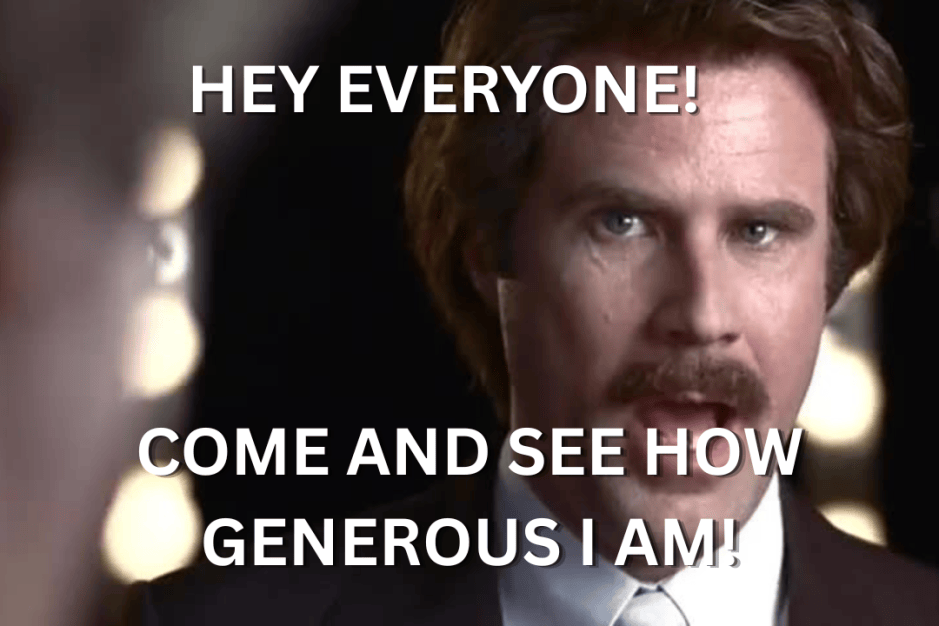
“Well done everyone…mostly me”
It has become a standard saying that I share with my kids at the end of a car trip. It started out as a show of appreciation for how well they behaved in the car on the way home from wherever we were, but something within me wanted to make sure that they knew I did most of the work by driving. It’s a joke…mostly, with a bit of ego.
The same instinct shows up in other areas of life that are supposed to be about someone else entirely. There can be some giant egos attempting to hide inside generous acts. The kind of ego that needs the name on everything they give to, that talks about it constantly to anyone within earshot, that compares their acts against others, not for the benefit of encouraging others to generous acts, but to boost their own profile.
The paradox is that good things can and will come from that sort of generosity. People will be helped, communities will grow and obstacles will be overcome. But probably not as much as they would if the ego was a little less.
But how do you know if there is a giant ego hiding behind your generous acts?
Simply put, if you are trying to prove to someone that you are generous (even if it is only you that you are trying to prove it to), then your ego is very active.
I am always happy to call out great acts of generosity; I think people should have names on buildings if they have given significantly to help create them. But it is not a competition.
Generosity doesn’t need the recognition, but also doesn’t need to be completely anonymous. It has the strength of character to handle both.
“Well done everyone”. (minus the “mostly me”).

“Choose generosity, knowing your actions can extend beyond yourself”. Neale Daniher – The Power of Choice
Maybe some people are just wired to be generous. They exude thoughtfulness, gratitude and generosity. It just seems to come naturally to them as they care for those around them and seem to be able to lessen the burdens of others simply by being in the same room.
I don’t think I’m one of those people…yet. I’m working on it, but it doesn’t exude from me, especially if you catch me before I’ve had my morning coffee, or if it’s too cold outside, or if my favourite sporting team recently lost (there is a specific set of conditions that need to be right…)
So, for the rest of us, I think the quote from Neale Daniher is an excellent place to start. He wrote “The Power of Choice” for his grandchildren, passing on what he had learned through life and his battle with Motor Neuron Disease, which he succumbed to in May 2026.
As a result, his quote carries a great deal of weight. Because before generosity exudes, it is chosen. It is an active choice, that sometimes may feel like it goes against the grain of what we might want, but the outcome of it, once chosen creates ramifications that ‘extend beyond yourself’. I think there is something in that, something that we all want. To make a difference to others in our world, be that our families, people in our community or those we will never meet. That is the power of generosity.
It doesn’t just happen. It needs to be chosen, on purpose, regardless of the coffee or the weather or the sporting result.

A gift without cost is a platitude.
Generosity is innately costly. When we give something away to someone else there is always the opportunity cost of what we could have done with that time, money, energy, idea or item.
It’s important to recognise that, perhaps mostly because it will be encouraging for you when you realise just how generous you already are. We can overlook the things we do for others or what we give away and say, “It was nothing really.” But it was something. Even if it was small.
It is also useful to notice an area in your life where you might think you are being generous, but you aren’t.
Does that mean that you have to make sure that every time you do something nice for someone else it costs you something?
If there is no thought given, nothing else you could have bought, or done with your time or your energy, even though it was probably a nice thing to do, it may not be an act of generosity. There is a difference between being nice and being generous.
There’s no need to be legalistic about it, it’s just good to recognise if your giving is costing you something. How much you are willing for it to cost you is entirely up to you.

Gerda Weissmann Klein, a Holocaust survivor, told a story about her friend, Ilse, when they were both in one of the worst Nazi concentration camps.
“She once found a raspberry in the gutter on the way to the factory…and she saved it all day long.
She carried it in her pocket – the temptation must have been incredible – and she gave it to me that night on a leaf. She had plucked a leaf through the barbed wire, washed it and presented me with one slightly bruised raspberry.”
Ilse’s only possession in the world was a bruised raspberry, that she found, and it became her sole focus to protect it and give it to her friend.
That is generosity in its purest form. She could have consumed it herself and no one would have known, but the idea of bringing her friend an ounce of joy in the darkest of places was much more important to her than anything else.
I don’t know about you, but upon reading about Ilse and Gerda I arrived at a point where I felt like I could never become generous like that. I am honestly not sure I could be capable of that sort of generosity or love.
At the same time, I am aware of the sense of joy that an outrageous, sacrificial act of generosity can bring.
I could buy punnets of raspberries today, set up a table on the street and hand them out one by one, to be just like Ilse, but that is ridiculous. It’s not about the raspberry, this story is about the sacrifice. The challenge that I find here is about whether my generosity costs me something, or if I am giving out of comfort. There is nothing wrong with that, but my sense is that generosity without a cost is a platitude.
She came running inside in tears.
He went running to his home, also in tears.
My 6-year-old daughter was able to give her side of the story, and others who were outside to witness the incident gave their side.
Thank goodness we have cameras out the front where I can re-watch and get the real story.
He had jumped and knocked her over, not through any malice. She was upset and gave him a push back.
How does one handle such a parenting moment?
My message to her was, “I will not be angry with you for standing up for yourself. You can still play together and be friends, and at the same time you can communicate what is okay and what is not. We will work on using your words more.”
It probably wasn’t perfect parenting, but I was trying to give my daughter confidence to stand up for herself and create healthy boundaries. Because healthy boundaries are vital for a generous life. You get to choose what is okay in a relationship and still have the capacity to be loving and generous to someone.
Much of the physical violence in our world is used by those who don’t have the words to communicate what they are feeling. It can be childish behaviour, even in adults. I am hoping to help my kids get the skills they need to communicate what they are feeling in the moment without physically lashing out.

I don’t garden. My grass is fake. My plants are indestructible. Watering happens automatically.
The most I do is pull out weeds and sweep up leaves. So I don’t know the joy of toiling in the soil and watching something I have cultivated grow into a beautiful plant or a food source that could be eaten. The idea of growth in a garden is beautiful and I know that some people love it, but I just don’t understand the draw. Perhaps when I get older it will become a thing for me, but I’m not holding my breath.
What I do understand is seeing things grow in other people. As they learn and develop in their skillsets, resilience and courage. Be they children or other individuals.
I coached my son’s cricket team last season. It was my first foray into the coaching world of kids sports. Was I good at it? Not really, but the kids did develop and improve from the start of the season to the end. Watching them go through that journey, seeing them enjoy that, and knowing that I had a tiny part to play in it, brought me joy.
I’m not sure who it was that said, “When you water someone else’s garden, your own begins to bloom.” But I think I know a little bit about what they were trying to say.

I catch myself in moments of gratitude. Usually I am alone, and a thought hits me,
“Boy, I am so grateful for…”
Usually it is about my wife, but often it is also about my kids. They are all so great, and it feels good to be reminded of that. I then begin to wish I wasn’t alone in that moment so I could share that with them.
“When I see them next time, I will tell them how I feel about them.”
Then I walk in the door to my home and normal life kicks in with the importance of getting people fed, bathed, read to and in bed at an appropriate time.
My grateful thoughts have disappeared and the desire to share them with my family is also gone.
I guess this is how we end up not expressing ourselves to those closest to us.
I know, I’m a cliché.
I think about it often, it’s my version of ‘if a tree falls in the woods and no one is around to hear it…’. If gratitude is unexpressed, is it really gratitude?
I’m not sure if it is. I think that if I feel grateful to someone for who they are, especially someone close to me, and I don’t express it, that is selfish on my part. Everyone deserves to have gratitude expressed to them, about them. Keeping that from people is unfair.
Every night at our dinner table, we share 3 things that we are grateful for in that day. It has become a list of things, which is great. Perhaps I can add “1 person that I am grateful to”, as a means to express my gratitude to those around me, and become a little less selfish.

“What’s missing?” The question creates a certain panic in me, even now.
You probably remember the classic game where you are presented with a tray of items covered with a small towel, you are shown the items for a few seconds which is your time to try to remember as many items as you can – stapler, rubber band, paperclip, toy car, watch, pencil sharpener. Then the towel is replaced and you need to write down as many items as you can remember.
Where it became ‘next level’ intense was when some items were removed, you are shown what is left, and you need to recall what is no longer there. This seemed to come really easily to some people, but I always struggled to see what wasn’t there.
Perhaps it is because I have a below average short-term memory, although I like to think that it is because I am content with what I have that I don’t feel the need to look for what’s missing (it’s probably the first one though). Maybe that’s the real difference between the two versions of the game — one trains you to notice what’s gone, the other to notice what’s still there.
Lao Tzu said:
“Be content with what you have; rejoice in the way things are. When you realize there is nothing lacking, the whole world belongs to you.”
Focusing on what is already there in life can be difficult. We get used to things, to waking up in the same bed, seeing the same people, eating the same food, and we can easily forget that we have a bed, people in our life who love us and food to eat. Rather than being ordinary things, they are in fact, extraordinary. Things we can rejoice in and be grateful for.
Perhaps that’s what Lao Tzu means when he said that when we realise there is nothing lacking that ‘the whole world belongs to you’. Out of a realisation that we have enough, anything becomes possible, we have the whole world at our feet, and we can afford to be generous with what we already have.

