Unintended Consequences

I recently found out something weird about jellyfish.

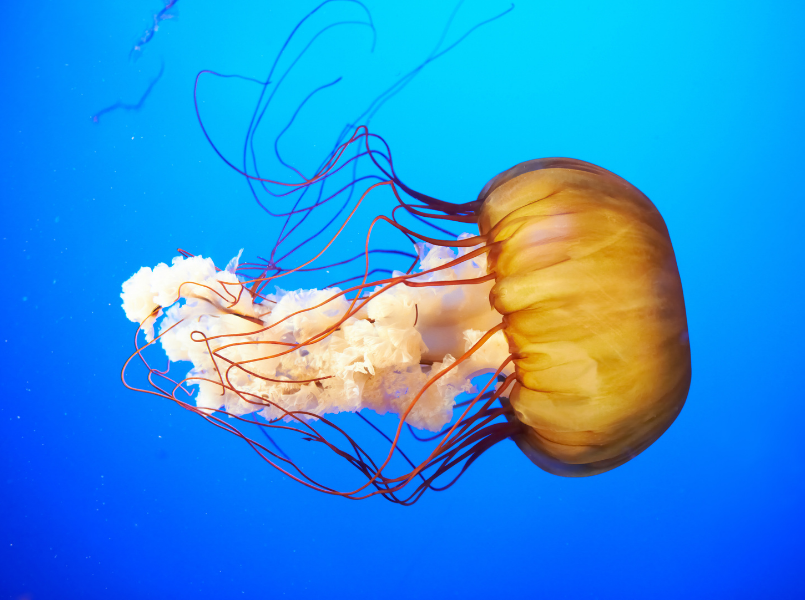
If you have one jellyfish and cut it in half, instead of having no jellyfish because it is dead, now you have two. Jellyfish regenerate. If it wasn’t so terrifying it would be amazing. Now I have nightmares about jellyfish rising up and taking over the world because they are the undead. Paranoia aside, it does speak to me about unintended consequences.

Life can be like trying to kill a jellyfish (metaphorically). We try to overcome obstacles and, in the process, create other obstacles that wouldn’t be there if it wasn’t for the action we just took.

For example, we recently had the joy of moving our 2 year old from a cot to a ‘big girl’ bed. She was having trouble going to sleep at night and we thought this move would help. No longer is she trapped when she has a sleep, she can get in and out as she pleases. Like when she drops her stuffed animals on the floor, she can hop out, get them and get back in to bed. She loves it and she was ready for it. Sleep time should become easier.

But instead, not only does she still struggle some nights to go to sleep, now, any time she wants, she can get out of bed and annoy her brother in the next room. The only time she is happy to stay in bed is when she drops her stuffed animals on the floor. Instead of hopping out to get them and jumping back in to bed, she calls out until someone does it for her. Unintended consequences.

In our world, unintended consequences are everywhere. I buy a coffee in Perth, it impacts the local café, their staff and families, the dairy farmers who provide the milk, the truck drivers who ship the milk, the distributors of said milk, as well as the whole coffee bean production line, from grower right through to roasters, wherever they may be in the world. A lot of things need to happen for me to have my morning pick me up.

If things work well, then people are positively impacted. If they don’t, people get pushed aside.

Generosity also has unintended consequences, both bad and good. Sometimes by doing something that you think is the best thing in that moment, may do some good, but also creates another problem/jellyfish. It doesn’t mean that we stop being generous. Instead, we grow in wisdom as we give so we can learn how to create the best possible outcomes with the least jellyfish. It takes time and experience, and humility to acknowledge we don’t know everything yet.

Give, Get More

“Like all the best things in life, the more you give, the more you have. That’s true of trust and friendship and it’s true of peace.” Rutger Bregman

I often talk about the riskiness of generosity. It’s like any other investment, there is never a guarantee that if you put money into something that you will get it back or get it back with interest. It’s the same when you give of yourself, your time, or your trust or your friendship. You never know if it will be received or reciprocated. It’s a risk.

It can be daunting when you hear about the bad things that happen in the world, and the seemingly endless supply of bad people. So, if you don’t trust anyone you can never be taken advantage of or hurt or swindled. You are safe from that.

But, on the flip side, if you have never been taken advantage of or hurt or swindled it means that you are not trusting anyone and missing out on the relationships and benefits that giving trust can bring. There is a cost to not trust people.

When you give trust, or friendship, or peace (non-violence), it is possible that it won’t be received or reciprocated, but the vast majority of time, it will be which creates more of what you have given. Leaving you richer than before.

Just because you may have had a bad experience where someone did the wrong thing to you, don’t write off all people (of that type, race, gender, persuasion). You are hurting yourself by doing that, and robbing the world of what your trust could bring.

Your Money Chooses

“Apart from the ballot box, philanthropy presents the one opportunity the individual has to express their meaningful choice over the direction in which our society will progress” – George K Kirstein

There is nothing I can do about it now. I voted. The election is over and now I sit back and wait to see where the leaders take the country, until the next election in three years when they ask my opinion again. I have this tiny moment in time to add my voice to the millions of others, and if most people agree then we might get somewhere. It’s hard to see what kind of impact I really have though. One vote in millions doesn’t seem to carry any weight at all, so why bother? I am sure that I’m not the only one who has thought that too because in my electorate alone, the informal votes ranked higher than a number of the candidates. That means that more people didn’t fill out their ballot paper correctly than those who voted for some candidates on purpose. The Australian Electoral Commissions suggests that 5% of all votes are informal and can’t be officially counted.

It’s easy to see how people can end up there. And it’s easy to see how people can disengage from community life thinking that they are unable to change anything, so why bother.

But that’s not true. The impact an individual can have on our world is huge, and we don’t have to wait for an election to be called to do it. Every day we have money within our control and what we do with it creates the society we live in. The organisations we give to shift our culture. When we give money to charities it shows politicians what people actually care about, not what they say they care about. Money moves our culture. Money moves our values. Money is a tool we can use to create the society we want. We get to choose what we do with it. So, give generously to organisations as a vote to create the world you want.

Enough is enough…except for when it isn’t

Too much of a good thing can still ruin your day. My wife made the most amazing pasta the other night. It is one of my favourite meals and I ate a significant amount of it. Even as I was still eating I said,

“I have eaten too much”

Then I continued to shovel pasta into my mouth.

It was amazing. Until it wasn’t. And later, it wasn’t amazing at all when I felt ill. I ruined a good thing by overdoing it.

We are lucky with food though, because most of the time we know when we have had enough, and we can stop eating and enjoy what we have consumed.

There are other things in life that don’t give you that signal that you have had enough. Money is the main one. How much is enough? Do you have an answer to that question? Or are you just working for more?

It’s something that most of us just drift into. The process of desiring more and more money so that we will have enough to buy that house, pay off the house, buy that car, go on that holiday, buy that other house. It becomes a never ending cycle. We would be wise to make a conscious decision of when enough will be enough. How much do we actually need, and then what do we do with the excess (giving some of it away is always a good idea). It’s such an important process because if we are unable to figure out what our enough is, then we are at the whim of the mighty dollar, which is a very scary place to be.

You will never be happy when enough isn’t.  – Seneca

Acceptance

“This is for you dad.”

You probably know the look very well. The large, expectant eyes of a small child, that is handing you, what can only be called a ‘picture’.

I’ve lost count of the number of times that I have been given drawings that were supposedly of me, or pieces of half-eaten food, or bits of paper with precious rubbish wrapped up in them by my kids, or other people’s kids as a precious gift. All of which I gratefully accepted, not because I wanted them, but because accepting the gift was an act of generosity. It gave my kids the chance to experience what is was like to give something away that they worked hard on, or meant a lot to them. They could learn about giving gifts that other people would actually want later, in that moment, it was more important for them to experience being generous.

Most people would agree with that. But it doesn’t just stop with kids learning how to give.

There have been other times in my life when someone has tried to be generous to me and I refused the gift. Not because I didn’t want it, but because it felt like too much. I felt insecure and inadequate, and like I would be a freeloader if I accepted it. So, I said no.

There is nothing wrong with saying no, but there are times when accepting a gift is an act of generosity because of what it gives the person who gives it. We know that there are many benefits when we give and it’s important not to rob people of that experience when they are trying to give to us.

In saying that, there are definite times to say ‘no’…(more to come on this)

Give First

One of the earliest Jewish teachings was about giving. The Jews were instructed to give 10% of what they had to the priests as an offering to God. It wasn’t the last 10%, or 10% from somewhere in the middle, it was the very first 10%, or first fruits to be set aside from their latest crop or produce they had harvested.

Religious doctrine aside, this is a great practical process, because it ensures that whatever happens, you are generous first before consuming what is left over. If you were to wait and see what was left after you had used up all that you needed, there wouldn’t be anything left to give away. Generally, people will spend and use what is available to them.

This is one thing that I struggle to do but it is one of the best disciplines to have. Being intentional about giving means knowing how much you want to give away, and to whom, then putting that amount aside before it gets used on other things.

Give first, then live. It will help keep your priorities straight and loosen the grip that the love of money can have on you.

Which One?

I recently saw a list of those who make significant political donations and I was a little surprised that there were a number who gave to both major parties in Australia. I guess it makes sense if you are looking to hedge your bets, so you don’t back the wrong horse, but it reminded me of how most people give money to charity.

It is very rare to come across someone who donates to only one charity. Instead, I often hear that people give to a few different ones, sometimes to two that are working in a similar space because, whilst they may be different organisations with slightly different approaches, the supporter likes them both. So why not?

It’s a portfolio style of giving, where you choose a selection of charities to support across a few different areas. Some will be similar, others will be doing something completely different so that you can diversify your portfolio. Over time you become more engaged and connected with the charities you support which leads to greater fulfilment in your giving, as you learn more about the difference that your generosity is having.

When You Win

Why does it seem that those with money seem to attract more money? Is it something supernatural, are they using “the Secret” or are they just very smart with handling their money already, so that when they get more it adds to what they already have?

There is a long list of people who have won the lottery and changed their financial lives dramatically, only to spend it all and end up back where they started from a few years later.

It makes sense when you think about it, because money doesn’t change you, it just makes you more of who you already are. How you are today will be how you are tomorrow regardless of what material changes happen for you.

If you are greedy already, if you are stingy already, if you are generous already, then getting a lump sum of money will only make you more of that thing. Once you get a lump sum of money it is too late to become something else. You may be able to fool yourself and others for a bit, and act generously temporarily but that will fade and your true nature will come out. The work needs to happen before you get it.

So, if you are waiting until you win the lottery to learn how to be generous you are fooling yourself and setting yourself up for a long and lonely life of being stingy.

Don’t wait. Do the work now and start your journey of generosity.

Why I Hate Economics

It’s more than a class that I barely passed in high school with a teacher who was as boring as a brown sweater vest. My problem with it is economists seem to think people behave rationally, without emotion. Models, legislature, and entire countries are based on that theory.

Take inflation for example. One of its main drivers is the fear that people have about inflation, who then behave in a manner that drives up inflation. Stick with me here –

The fear of rising prices causes people to buy more items now, because the price will rise in the next few weeks or months. This pushes up demand for the products, which then become more expensive because there are less products around, and scarcity creates a willingness for people to pay higher prices – causing inflation. Emotional.

Also, I have an issue with the simple construct of supply and demand. It suggests that if you can make a cheaper version of an existing product, then people will rationally buy the cheaper product, because why would you pay more money for something when you can get it cheaper elsewhere? This completely misses the connection that some have with certain brands, for which they are willing to pay more money, even though the product is the same. Emotional. We all have those traits. We all pay more money for something than we have to, because of an affiliation with a brand, or some other emotional connection.

You see, economics is filled with simple models and diagrams explaining one of the most complicated elements of our world, the market. Many are happy to rely on the market to fix all of society’s problems. As if the market is an all knowing, all powerful and altogether good being which, if left to its own devices, will take care of us all. But it is just a thing. It’s a system that we created and use for our own benefit, and hopefully the benefit of others. As with anything, it’s the users which dictate how much good or ill comes from a system. And it’s the emotions which drive the users’ decisions. So, it’s emotion which rules our market, not logic.

Or as Seth Godin puts it,

“We like to think we make complicated decisions based on rational analysis, but most of the time, we actually make an emotional decision and then invent a rational analysis to justify it.”

Mostly though, it’s the fact that there doesn’t seem to be any space for generosity within economics. It doesn’t appear to be logical, or good business, or benefit the market at all – but it is and does all those things. There just isn’t a simple diagram for it.

I’m Not Asking for Your Money

I work for a charity and meet with people who donate significant amounts, but I don’t ask them to give money.

I used to do that, and it felt wrong. I felt like I was apologising every time I wanted to meet with them and that they thought I only wanted something from them…which was kind of true – their money.

I got tired of that feeling and of asking people to give money, so I decided to try something else.

Instead of asking people to give, I now invite people to fulfil their purpose through generosity. By giving money to Opportunity, an organisation that they are passionate about, our supporters are finding a way to fulfil their purpose.

They are bringing dignity to those living in poverty.

They are giving back some of what they have received.

They are living out their values.

They are showing care and concern for their fellow human beings.

They are releasing the hold that money can have on those who have it.

They are being generous and reaping the rewards that generosity bring.

So I don’t ask for money. I offer a pathway to purpose.