Generous God (but not selfless…)

Genesis 1:26-28
God spoke: “Let us make human beings in our image, make them reflecting our nature
So they can be responsible for the fish in the sea, the birds in the air, the cattle,
And, yes, Earth itself, and every animal that moves on the face of Earth.”
God created human beings; he created them godlike,
Reflecting God’s nature. He created them male and female.
God blessed them.


At the pinnacle of creation, God brings in people. He creates them, but not as an addition to what He already made. He created them to enjoy and manage. To participate in the life of His creation, and to participate in life with Him.

God put so much of Himself in to creating this world – because He is not one to do things half-hearted. He called it good. He was so pleased with it. Proud of what He had made. In light of that, it makes the invitation to include people and delegate authority to them so much more staggering. It is an incredibly generous gesture, from the heart of a generous God.

That’s how He created us too. As generous humans. It’s innate within us to be generous and thoughtful to the people and environment around us. It’s part of who we are and why we exist. As with anything though, if you ignore the generous inklings (perhaps you can read that as ‘the promptings of the Spirit’), then over time the desire for generous living can become easier to ignore and ultimately disappear from our character. That is how we find ourselves in a world with some who don’t appear to be generous at all. It can be fixed though; generosity breeds generosity.

Generous God, generous creation, generous people.

There is no doubt that things are not as they should be…but it is still good, with glimpses of heaven on earth.

I don’t see this creative and generous act of God as completely selfless though. I don’t necessarily see God Himself as completely selfless. He is relational and therefore He receives the benefit of relating with us and His creation. This brings Him joy. He receives because of His generosity. I wouldn’t call it payment or reward, more like fruit. Fruit that He knows is coming. Perhaps our thinking of how selflessness is an attribute that we should strive for, needs adjustment. I don’t see it mentioned anywhere in the Bible – it is definitely not a fruit of the Spirit.

This can change the way that we think about our generosity towards others. It releases us to be generous with reckless abandon and willingly receive the benefits, or fruit, that come our way as a result. We don’t need to shy away from it or be embarrassed because we feel good when we give. Not that feeling good becomes the sole motivation for generosity, but it’s ok to receive benefit for doing good, for being generous and thoughtful. This does not diminish the work that we do.

Occasionally I think of the dark side of relationships and how God reaps the fruit of that too. He endures the worst of it, as we do. Rejection, hurt, dishonesty, hatred, fear and misunderstanding – all at the hands of what He created. Because of us. It’s not all love songs and roses. Still, He is generous with love for us and we bring Him joy.

Would We Give if it Wasn’t Tax Deductible?

There is a short answer, a longer answer and a philosophical answer…

The short answer is “Yes and No”.

Yes we would but it probably wouldn’t be as much. Giving to organisations that provide a tax deduction financially assists those who are giving. People would prefer that not-for-profit organisations get their hard earned money rather than it ending up in the hands of the government through paying tax.

The Longer Answer

The longer answer is to do with the structure the Australian government puts into place. The Federal Government desires that its citizens make philanthropic donations to not-for-profit organisations because many of those organisations exist to complement existing government agencies or they can even fill gaps which government agencies are unable to get to. In short, the Australian Government likes it when we give and want us to do so. As a result, there are many organisations which are Deductible Gift Recipients, meaning that when we donate to them we can receive a tax deduction. To become a Deductible Gift Recipient an organisation must go through an application process and fulfil a list of requirements e.g. must have an ABN, be located in Australia and must fall within a Deductible Gift Recipient category

You can find a full Australian list here.

The benefit to us as citizens and donors is that we can be sure that when we donate to one of these organisations, they have been vetted by a government agency to ensure that they are legitimate. They aren’t perfect and we still have a responsibility to do our own research before we give but we can rest assured that the government is aware of the organisation and what they are involved in. Plus, there’s the tax deduction – that’s another benefit.

The Philosophical Answer

This answer is to do with selfless acts, and as with most philosophical discussion the answer is neither ‘yes’ or ‘no’. People wrestle with and debate the idea of acting in a completely selfless way; doing something good for someone without getting anything in return (whatever ‘something good’ means – this is up for debate itself, but for now let’s just sit with the definition of an action from one person designed for the benefit of another). The real question that gets asked is ‘if we get something in return for doing something good, does it cancel out the good that has been done?’

It doesn’t take very long to figure out that there is no such thing as a completely selfless act (perhaps apart from that time when God came to earth and died for us – but I think that even He received some benefit as a result… maybe that’s a topic for another time), because we get some sort of benefit from any good thing that we do. Whether it is a thank you, a smile, an award, a tax deduction, recognition or even just a good feeling. You can’t stop it. And if you could, the amount of effort required to ensure that you received no benefit from something good that you would be so exorbitant that it would make your life miserable. It all comes down to motivation – why we do good things for other people.

We want to do good for others for a variety of reasons – we might have a heart for a certain demographic of people because we have similar experiences, or we feel a responsibility to help, or our faith might drive us, or a desire to impress others, or it is something we do offset the guilt felt in other areas of life, or it is to feel good about ourselves. In reality, I think it can be all of the above at the same time. People are complex with conscious and subconscious motivations and it’s good to seek to find out why we do the things that we do, but I don’t think we will ever fully understand ourselves, not in the short term anyway. So it is a good idea to keep doing good things for people as we journey through our self-discovery. It is okay to get a benefit along the way…so make a tax deductible donation before June 30…

www.opportunity.org.au


Asking for Money is Okay…

These days, there’s a lot of work to do. Of this we can all agree. Whether your focus is on providing for yourself, your family, your future or looking to change something in the world that is not right, we all have a long ‘to-do’ list and limited time. The main issue is that there are few tangible indicators that tell us when we have achieved what we have set out to do. There is always something extra to work towards. More money to make, more security to provide, more protection to put into place, more awareness to create, more projects to start, more money to raise. There is always more.

For me, it has always been about providing hope and security for kids in developing countries. Within any community it is children, the elderly and people with a disability who are most vulnerable, and more often than not you can add women to that list. My heart has been to enable vulnerable children to reach their full potential in life, through getting the right nutrition, access to education and a safe place to grow up and engage their creativity. As a world we have come a long way but with 161 million children globally suffering from stunting due to an insufficient intake of nutrients, and 124 million children and adolescents who are not attending school, there is much to do.

I have highlighted recently a few things that hopefully give people a chance to ask some questions around giving money.  If, when, how, why and to what you give to is such a personal experience and I believe the worst thing that we can do is to not talk about it. The more we do talk about it the more we learn about giving and philanthropy. I once heard someone tell me that they didn’t want to hear any more about giving money – they had decided to give and they knew all that they needed to about it. A part of me died inside, not only because it was someone refusing to engage is a subject that I care about, but because this attitude is dangerous in all areas of life. If we ever reach a point when we feel like we have learned all that we need to about a subject then we have stopped living, and we have become proud and arrogant. There is always more to learn. So, we keep talking about it.

I ask people for money. That’s what I do. It sounds a little weird when you say it out loud but essentially that’s my job. A few years ago I had an epiphany that helped me to understand why I do what I do. Firstly, I fundraise because it is good for the people that I serve. I believe that all people deserve the ability to reach their God-given potential, and the organisation I work for are leading the way in ensuring that this happens.

Secondly, I fundraise because it is good for the giver. I have often mentioned that we are designed to give back and it is actually good for us to do so, so when I ask someone to give money towards life-changing, life-giving work, I am not asking for my benefit or for the benefit of the people we serve alone, but it is also for the benefit of those who give. If I didn’t ask people to get involved in this, then I would be doing them a dis-service by robbing them of an opportunity to engage in something that they will enjoy. The worst they can do is say no, and I’m okay with that. It means they have thought about it and made the decision that it is not for them at this time, but I always hold hope for the future…

Giving is a necessary part of life because in our world, a few people have most of the wealth and most people only have some of the wealth. We work to make things a little better and ask people to give to that.  I have come to the conclusion that it is okay to ask for money. And it’s okay for people to choose not to give. But it’s not okay to make people feel guilty about what they do or do not give to.

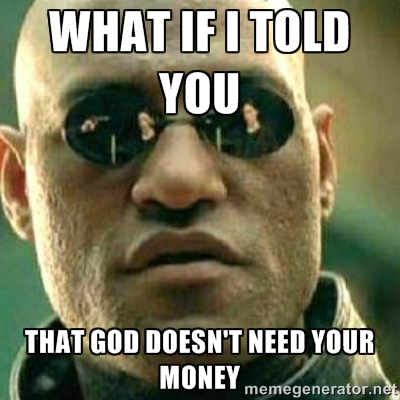
God Doesn’t Need Your Money

I can’t remember his name, or even exactly where we were, but we were waiting for a ride somewhere in the Eastern suburbs of Melbourne when he said it. “God has His own economy.” I never saw that guy again after that day – we spent the entire day playing basketball against some inmates in one of the local prisons and the only thing I remember about him was what he said to me that morning. We were talking about how things were financially tight and I couldn’t see a way forward. There were expenses coming up and I didn’t know how we were going to meet them (I’m not sure how we got to that point in the conversation so quickly) and that’s when he said it. “God has His own economy.”

He went on to explain his understanding of God, how He is not restricted by the things that we are restricted by. He isn’t confined by a low pay packet, or by a pay cycle, or a shortfall. If God wants something to happen, He will find a way to finance it and he can work outside of our understanding and bring money from places we never knew about.

That one phrase from the unknown guy as we stood on the side of the road waiting, challenged the way that I thought about money and the way that I thought about God. Even though it can raise some curly questions, it doesn’t mean that it is not the truth.

I believe that God is all powerful, all knowing and all loving. That is something that I learned as a child and it is something that I have had to wrestle with time and time again as I have grown up and faced all sorts of different issues that come our way as adults. My understanding of what His power, wisdom and love look like have changed over the years, but I still believe those things about God.

It struck me a few years ago that there was an element of arrogance that motivated me to do certain things that I considered “works for God”. This ranged from being part of the local church to giving money to the church and other organisations. One part of the motivation came from a place of responding to God’s goodness and my “works” were an overflow of that. But the arrogant part of my motivation spoke in a soft voice in my head and said, “If you don’t do this for God then no one will and God won’t be able to fulfil His plan.”

Now, don’t get me wrong, I believe that we are all called to something special and that God has prepared some great things for us to do (Ephesians 2:10), but I realised that if I didn’t do the great things that God was calling me to, then God’s plan for the world was not going to fall apart. He wasn’t sitting in heaven watching earth on a TV, like we would watch a football game, shouting at the players as they make mistakes, seeing the game slip away and being helpless to do anything about it, as any spectator is. (Your TV yelling isn’t helping, so stop doing that, for everyone’s sake…)

This type of attitude is the deepest sort of arrogance because it suggests that God is only doing good things in the world wherever I am, or, at a stretch, perhaps He is doing good things with some other people that I think are good. But outside of that parameter He can do nothing. This suggests that He is solely reliant upon us to achieve something and if we have a bad day, then so does He. But God is not a spectator or coach watching the world and making suggestions on what might be a good strategy. He is so involved with His creation that nothing happens without Him being at the centre of it. What that means for us is that God does not require us to do good things in this world. He could feed the poor, negotiate world peace and heal all the sick in a moment. I absolutely believe that (which leads to more of those difficult questions).

The beauty in all of that is that whilst he doesn’t need us to do any of these things, He invites us to be part of it. He wants to use us. To be honest I don’t fully understand why, except that being part of what God is already doing on this planet has become my life’s purpose.

I didn’t wake up 15 years ago and discover poverty, nor did I discover poverty alleviation or the beauty and simplicity of microfinance. This has been happening throughout history and there is a special place in the heart of God for the poor (Leviticus 19:18, Matthew 19:21, Galatians 2:10 to name a few). We see throughout history that God has used His people, and quite often He uses people who, by their own admission, wouldn’t be considered “God followers”, to bring about justice in this world. That is actually a gift for us; to know that our involvement in any good work is not necessary but we get to be involved anyway. It is a humbling reality.

It’s not only humbling to be invited to participate in what God is doing, but it is also good for us. We receive the emotional benefits from giving back, and God knows that, so He wants to ensure that we have the opportunity to receive from our giving. His invitation to give and be involved is partly for our own benefit.

Mostly, though, it is about obedience. I have heard that you can tell a person’s priorities by how they spend their time. I have also heard that you can tell their priorities by how they spend their money. I think both are true and they are a real reflection of who we are and what we believe is important in life. God calls us to give to the poor, not because He needs us to, but He wants us to be part of what He is doing, to be obedient, and for us to receive the benefits of giving.

I feel that it can be dangerous for someone who works for a not-for-profit that relies upon donations to function to then say, ‘God doesn’t need your money.’ The fear is that there will be some who will take that as a reason not to give. But upon reflection, if someone responds like that, then they were looking for an excuse anyway and my writing is not for them. The aim of this post is to come to a place where we are open for God to show us what He would like us to give to. God doesn’t need your money…He chooses to use it and us at the same time.

Perhaps He is asking you now to invest your time, money or resources to help families living in poverty transform their lives?

Here are some questions that come up after thinking through the ramifications of God not needing our money…

  • If God has His own economy how can He stand by and watch people suffer and die because they don’t have enough?
  • What does that say about God?
  • What does that say about us?
  • Why was I born in a developed country and the majority of the world wasn’t?

Some of these I don’t have an answer for, some I am working through possible answers but I am keen to hear what you think…